Neurolight Series — Part VI
When Institutions Forget, Humans Pay the Price
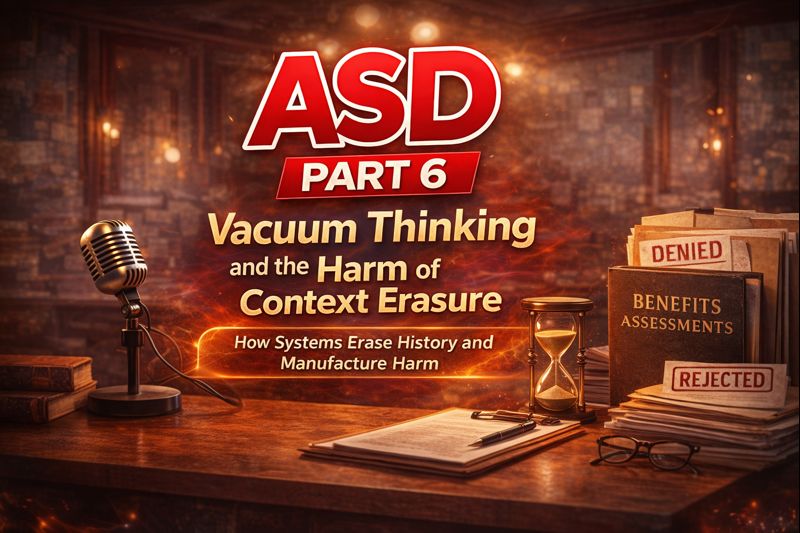
Abstract
Modern disability and healthcare systems often operate under a principle of vacuum thinking—the treatment of each assessment, referral, or interaction as isolated from all prior history. While administratively convenient, this approach creates cumulative harm for autistic and disabled people whose lives are defined by continuity, fluctuation, and long-term constraint. This article examines how context erasure functions as a form of structural violence, forcing individuals to repeatedly expose themselves to harm, retell distress, and re-enter hostile systems in order to access basic care or support. It argues that vacuum thinking is not neutral, but a design choice that shifts institutional risk onto vulnerable bodies.
1. What Is Vacuum Thinking?
Vacuum thinking is the institutional practice of treating each interaction as if it exists in isolation.
In practice, it means:
- prior assessments are discounted
- historical evidence is minimized
- cumulative harm is ignored
- systemic patterns are denied
The system behaves as if memory itself is a liability.
Humans, however, do not live in fragments.
We live in continuity.
2. Why Systems Prefer the Vacuum
Vacuum thinking serves institutions, not people.
By isolating each decision:
- responsibility for past harm disappears
- patterns of failure remain unexamined
- accountability is endlessly deferred
Each rejection, discharge, or denial can be framed as:
“A fresh, independent decision.”
This protects the system from having to explain itself across time.
3. The Human Cost of Context Erasure
For autistic and disabled people, vacuum thinking produces predictable harm:
- repeated retelling of traumatic experiences
- constant re-proving of legitimacy
- exhaustion and withdrawal from care
- internalized self-doubt
The system calls this “process.”
The body experiences it as erosion.
4. Vacuum Thinking in Disability Assessment
Benefits assessments frequently operate as if:
- past decisions never occurred
- repeated rejections carry no meaning
- institutional error is impossible
Each new assessment resets the narrative burden entirely onto the claimant.
The question is never:
“Why has this person been failed repeatedly?”
But always:
“Why can’t they explain it better this time?”
5. The UK Healthcare Trap: False Choice
In UK healthcare, vacuum thinking creates a particularly cruel contradiction.
The narrative offered is:
“If the NHS is slow, you can always go private.”
The reality for disabled people on UC is very different:
- private care is financially unsustainable
- it is often limited to a single encounter
- NHS services may refuse follow-up on the same issue
- private diagnoses can be ignored or invalidated
- waiting lists are reset from the beginning
The system frames this as choice.
In truth, it is coerced exposure to harm.
6. When Access Requires Endurance of Harm
For many disabled people, the choice is not between options.
It is between:
- enduring harmful systems
- or having no access to care at all
Vacuum thinking ensures that:
- harm is never cumulative enough to matter
- but always immediate enough to be unavoidable
This is not care.
It is attrition.
7. Why Autistic People Are Disproportionately Affected
Autistic people rely on:
- continuity
- pattern recognition
- stable understanding over time
Vacuum thinking does the opposite:
- it resets context
- ignores fluctuation
- punishes consistency
- treats distress as episodic rather than structural
The result is repeated invalidation disguised as neutrality.
8. Poverty Removes the Illusion of Choice
When you are:
- unemployed
- disabled
- dependent on UC
- reliant on family support
There is no safety net for experimentation.
Every interaction with the system carries risk:
- financial
- psychological
- physical
Vacuum thinking assumes infinite resilience.
Disabled bodies do not have it.
9. Risk Management Disguised as Neutrality
Vacuum thinking is often defended as fairness.
In reality, it is risk management:
- safer to deny than to support
- safer to forget than to remember
- safer to reset than to repair
False negatives protect institutions. The harm is externalized onto individuals.
10. What a Memory-Based System Would Require
Ethical systems would:
- track cumulative decisions
- audit repeated rejections
- treat history as evidence
- recognize institutional patterns
- allow continuity of care
- acknowledge system-caused harm
Memory creates accountability. That is why it is avoided.
Conclusion
Vacuum thinking is not a failure of empathy.
It is a structural choice.
By erasing context, systems erase responsibility. By erasing history, they manufacture repeated harm.
Disabled people are not failing to access care. They are being forced to survive systems that refuse to remember them.
Care requires memory. Justice requires continuity. And humans cannot be reduced to moments without being harmed.
References
- NICE NG128 (2018). Autism spectrum disorder in adults.
- Department for Work and Pensions (UK). PIP Assessment Guide.
- Livingston, L., & Happé, F. (2017). Compensation in autism.
- Crenshaw, K. (1989). Intersectionality and structural power.