🧠 When we reduce people to labels, we lose the system that makes them who they are.
ADHD and Autism: More Than Diagnostic Categories
ADHD and Autism Spectrum Disorder (ASD) are commonly discussed as discrete clinical categories. In practice, however, these labels describe broad neurodevelopmental patterns, not uniform experiences.
Both ADHD and ASD:
- have strong genetic foundations
- emerge through differences in nervous system development
- affect perception, regulation, cognition, and interaction
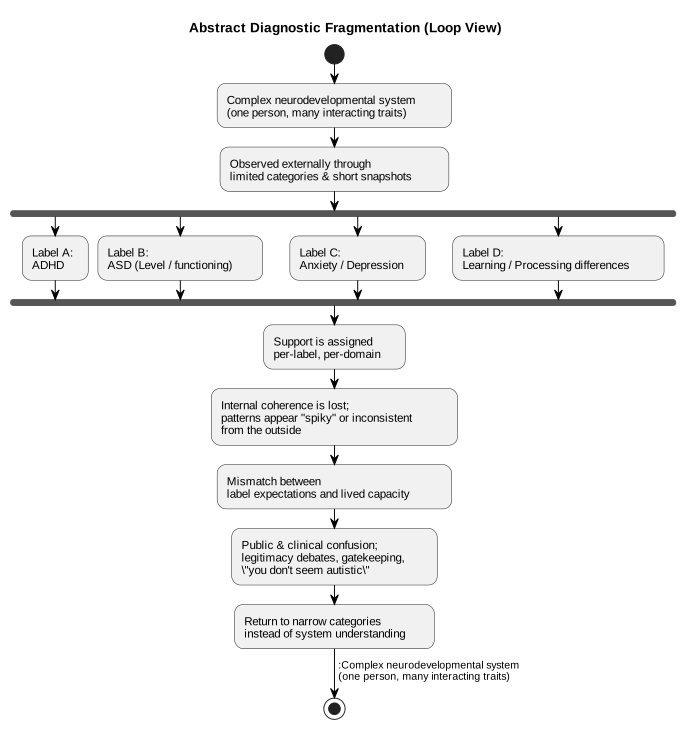
Crucially, they do not exist in isolation. Each individual’s neurodevelopment unfolds as a whole system, shaped by multiple interacting traits rather than a single diagnostic axis.
The Missing Systemic View
Clinical frameworks often isolate symptoms:
- attention
- communication
- social interaction
- sensory processing
But the nervous system does not develop in compartments.
What is often described clinically as comorbidities — such as:
- processing speed differences
- learning disabilities
- executive dysfunction
- sensory integration differences
— are not secondary add-ons. They are integral parts of how ADHD and autism present in real people.
When these interacting traits are separated into categories, the full picture is lost.
Why Labels Fail the Individual
Terms such as “high-functioning” and “low-functioning” are especially misleading.
They are based on externally visible markers:
- speech
- apparent independence
- surface-level social performance
Rather than internal capacity:
- cognitive load
- processing limits
- energy expenditure
- sustainability over time
An individual may meet criteria associated with “Level 1” autism — fluent speech, intellectual ability, apparent independence — while being entirely unable to sustain full-time work or continuous cognitive demands.
The label implies support needs that do not match lived reality.
ADHD, Autism, and the Myth of Uniform Presentation
ADHD is often framed as a single condition with a few subtypes. In reality, its presentation varies widely because it interacts with:
- autistic traits
- learning profiles
- sensory sensitivity
- emotional regulation differences
Similarly, autism does not present as a linear spectrum from “mild” to “severe.” It presents as multidimensional variation, where strengths and limitations emerge in different domains simultaneously.
This complexity is often described as a “spiky profile.”
But the spikes are not random.
“Spiky Profiles” Are Not Random
From the outside, neurodivergent abilities can appear inconsistent:
- high verbal ability alongside slow processing
- deep conceptual insight paired with poor task initiation
- strong pattern recognition but limited working memory
This appears “spiky” only when viewed without context.
From a systems perspective, these patterns are internally coherent. They arise from how different neural processes interact, compensate, and compete for limited resources.
The issue is not unpredictability —
it is misinterpretation.
How Labels Fuel Stigma and Debate
When categories fail to capture complexity, they invite:
- skepticism (“you don’t look autistic”)
- comparison (“others manage, why can’t you?”)
- invalidation (“that’s just ADHD, not autism”)
Public debate then shifts away from support and toward:
- gatekeeping
- hierarchy of “severity”
- arguments over legitimacy
This does not happen because neurodivergence is unclear —
it happens because the framework is too narrow.
Toward a More Accurate Model
A more useful understanding of ADHD and autism would:
- center nervous system development, not checklists
- describe support needs across multiple domains
- acknowledge interacting traits rather than isolating diagnoses
- focus on sustainability, not appearance
This does not mean abandoning diagnosis.
It means treating labels as entry points, not conclusions.
A Final Thought
Neurodivergent lives cannot be reduced to single labels without losing the truth of how they are lived. Understanding requires moving from categories to systems — from surface traits to internal realities.
Clarity does not come from simplifying people.
It comes from seeing them fully.
This article is part of the Neurodivergence series on NeuroLight.
If this resonates, you are not alone — and your experience is not an exception. It is the rule.