
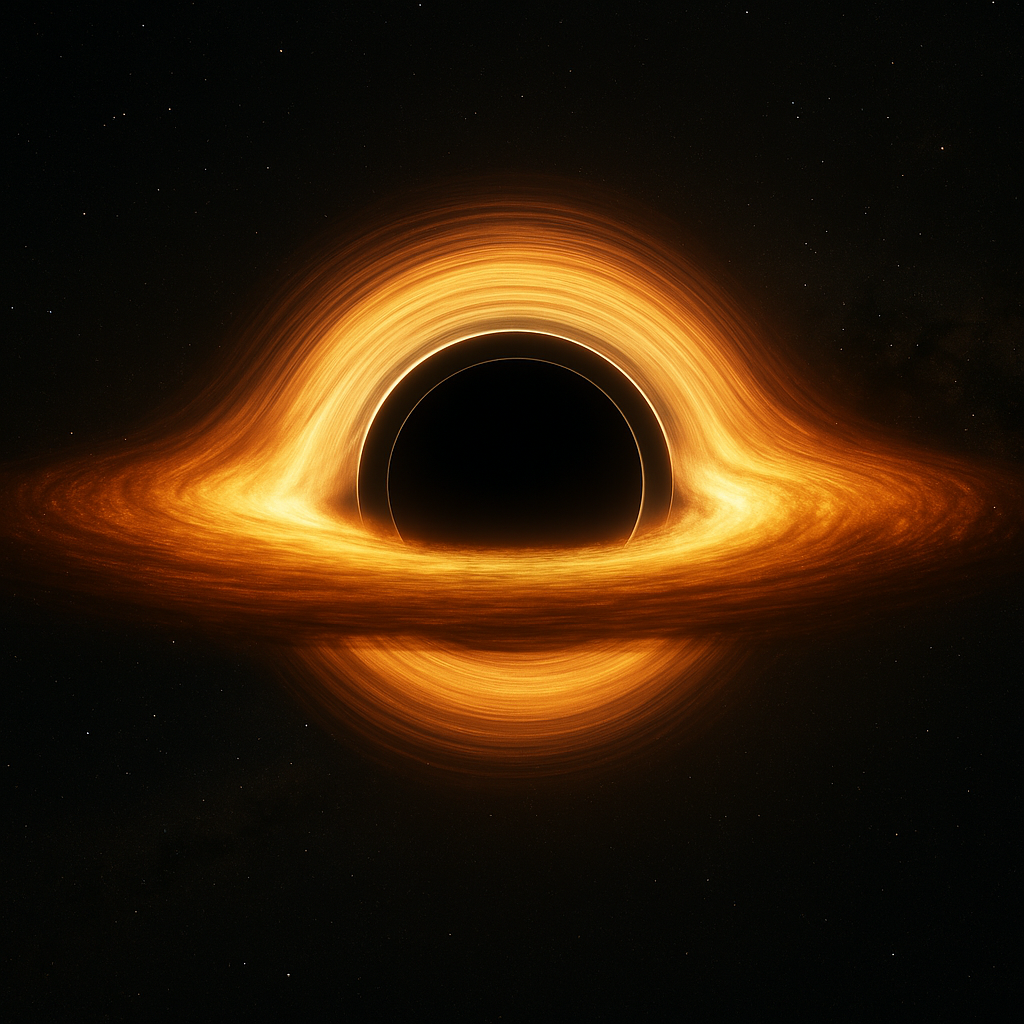
1. Introduction
Black holes are some of the most fascinating and counterintuitive objects in the universe. They bend time, stretch space, drag geometry itself, and challenge our understanding of causality. Yet much of their behavior can be understood through a few core spacetime concepts.
This mega-article brings together:
- Static spacetime around Schwarzschild black holes
- Rotating Kerr black holes
- Event horizons as causal boundaries
- Gravitational and kinematic time dilation
- What it feels like to fall inside
Bitboo will guide the way — clear, precise, and gently curious.
2. Static Spacetime Around Schwarzschild Black Holes
A Schwarzschild black hole is the simplest black hole solution. It describes:
- A spherical, non-rotating, uncharged mass
- No matter falling in
- No change in mass over time
Under these conditions, spacetime outside the black hole is said to be static.
2.1 What Does “Static” Mean in Physics?
A spacetime is static if:
- The geometry does not change with time
- There is no rotation
- The metric components are time-independent
This does not mean nothing happens near the black hole.
You can still fall in, light still bends, clocks tick slowly—those are effects of the existing geometry, not changes in it.
2.2 Schwarzschild Metric
The metric for a non-rotating black hole is:
[ ds^2 = -\left(1 - \frac{2GM}{c^2 r}\right)c^2 dt^2 + \left(1 - \frac{2GM}{c^2 r}\right)^{-1} dr^2 + r^2 d\Omega^2. ]
This geometry is unchanging—hence, static.
3. When Spacetime Becomes Dynamic
A black hole is not static when:
- Its mass increases (accretion)
- Its mass decreases (Hawking radiation)
- It interacts with surrounding matter or radiation
- It merges with another compact object
- It rotates (this makes it stationary, not static)
Real astrophysical black holes are rarely perfectly static.
4. Kerr Black Holes (Rotating Black Holes)
Most black holes in the universe rotate. The rotation creates a Kerr spacetime, which is more complex and dynamic than Schwarzschild.
4.1 Frame Dragging
A rotating mass drags spacetime with it.
Near a Kerr black hole:
- Spacetime itself rotates
- No object can stay still relative to distant stars
- Even light must rotate with the hole
This effect is known as frame dragging.
4.2 The Ergosphere
Rotation creates a bulging region outside the event horizon called the ergosphere.
Inside it:
- You cannot remain stationary
- Space is dragged at faster-than-light “coordinate speed”
- Energy extraction is theoretically possible (Penrose process)
4.3 Two Horizons
Kerr black holes contain:
- An outer event horizon
- An inner Cauchy horizon, where predictability breaks down
4.4 Ring Singularity
Rather than a point, Kerr geometry produces a ring-shaped singularity with finite radius.
This leads to mathematical spacetime extensions whose physical reality remains uncertain.
5. Event Horizons — What They Really Are
An event horizon is not a surface or barrier.
It is a light-like boundary in spacetime:
Events inside cannot influence the outside universe.
5.1 Local Experience
Crossing the event horizon:
- Feels like nothing special
- No sudden force or wall
- Happens in finite proper time
5.2 Outside Observer View
From far away:
- You appear to slow down
- Your light redshifts
- You freeze at the horizon boundary
- You fade away
This is due to gravitational time dilation.
6. Gravitational Time Dilation
Time passes differently depending on gravitational potential.
6.1 Schwarzschild Time Dilation
The relationship:
[ d\tau = dt \sqrt{1 - \frac{2GM}{c^2 r}} ]
As you approach the Schwarzschild radius:
- Time slows dramatically
- Light loses energy and redshifts
- Distant observers see your clock nearly stop
6.2 Time Dilation in Kerr Spacetime
Rotation adds kinematic effects:
- Frame dragging forces motion
- Kinematic time dilation stacks on top of gravitational
- Time can slow even more drastically
7. Falling Into a Kerr Black Hole
7.1 Outside Observer Perspective
You appear to:
- Slow down
- Redshift
- Freeze near the horizon
7.2 Your Perspective
You:
- Cross the horizon smoothly
- Feel stronger curvature
- Get twisted sideways by rotation
- Are funneled toward the interior
- Cannot escape any future direction
Inside the inner horizon, the geometry becomes unpredictable and unstable.
8. Summary
This mega-article unified several core concepts:
- Static spacetime means unchanging geometry, not gentle physics
- Schwarzschild black holes are calm, spherical, and static
- Kerr black holes rotate and drag spacetime with them
- Event horizons are global causal boundaries
- Time dilation shapes how observers perceive black holes
- Falling inside reveals extreme but predictable spacetime behavior
Black holes are not just cosmic monsters—they are precise, beautiful solutions of general relativity. And Bitboo hopes this brought clarity, comfort, and curiosity to your understanding of these extraordinary objects.